Wednesday, May 14, 2014

"I wept over Dido..."

"You're running away--from me? Oh I pray you
by these tears, by the faith in your right hand--
what have I left myself in all my pain?--
by our wedding vows, the marriage we began,
if I deserve some decency from you now,
if anything mine has ever won your heart...
...If you'd only left a baby in my arms--our child--
before you deserted me!"


"What did you feel then, Dido, seeing this?
How deep were the groans you uttered, gazing now
from the city heights to watch the broad beaches, 
seething with action...
... Love, you tyrant!
To what extremes won't you compel our hearts
Again, she resorts to tears, driven to move the man,
or try, with prayers--a suppliant kneeling, humbling
her pride to passion. She if die she must,
she'll leave no way untried."

"... But Dido,
trembling, desperate now with the monstrous thing afoot--
her bloodshot eyes rolling, quivering cheeks blotched
and pale with imminent death--goes bursting through
the doors to the inner courtyard, clambers in frenzy
up the soaring pyre and unsheathes a sword, a Trojan sword
she once sought as a gift, but not for such an end." 

All at once, in the midst of her last words,
her women see her doubled over the sword, the blood
foaming over the blade, her hands splattered red.
A scream goes stabbing up to the high roofs,
Rumor raves like a Maenad through the shocked city--
sobs, and grief, and the wails of women ringing out..."
Virgil. Book 4, The Aeneid, translated by Robert Fagles (New York: Penguin 2006)/ Image: "The Death of Dido," Claude-Augustin Cayot (1711).

In two posts very long ago, I wrote about wanderers with causes: Aeneas, and then St. Augustine. When it came to the latter, I suggested that his tears at Dido's death, were, in fact, the greatest manifestation of the godly: empathy. I have been thinking about Augustine lately, and I ended up revisiting the Confessions, only to be struck by the fact that all of Augustine's tears are for Dido. They are not for the broken love of Dido and Aeneas, for the subsequent destruction of Carthage, or for a wandering Aeneas: "I wept over Dido," "...over the death of Dido dying for the love of Aeneas." Remarkable, then, is Augustine's affinity with the trials of the queen, the pain of a bereaved woman, a displaced feminine desire, and the anguish of the female heart. On the one hand, Dido is Odysseus's Circe, a designated moment in Aeneas' journey towards the founding of Rome. On the other hand, she is, as Augustine-- and in a brief respite-- Virgil, permit us to see her: "an early suppliant, kneeling." My previous post too dealt with the unnerving image of the lover as abject, in the posture of worship, acutely aware yet numb to the loss of the self. In a sharp contrast to the privacy and seclusion offered to this figure by Eliot, here we have gaze upon gaze heaped upon Dido: her own uncontrolled rage seems to shatter the meter; Virgil's own inquiry is directed upon her "feeling;" "her women" are witness to her suicide; Augustine, the empathetic reader, forces his own emergence/y through a particular reading of Dido.

Dido is older than most tragic heroines who have died for love, but there is a terrible anachronism around her figure: the absence of solitude. That is to say, Dido's abandonment, her subsequent grief, the markedness of her state, and her final act are made unforgivably public. Juliet drinks the poison alone, Isolde dies next to Tristan, Emma schedules her dose of arsenic--in the embracing, productive darkness of the private. Dido's terrible tragedy, then, is not just what she undergoes as a woman left childless and insignificant by her half-god husband, whom she ironically married in the deepest seclusion. Her tragedy is the strange condition of being alone amid so many, of being so very visible bearing a pain that cannot be touched or healed, of not having the privilege of solitude that will be accorded to several women in love after her. St. Augustine, then, in his consumption of her circumstances participates in the spectacle of the doomed, hysterical woman that Dido ostensibly seems to represent.

Before I end, I want to return to the image that I began this discussion with: Dido as suppliant, kneeling before Aeneas. In other words, she prays before Aeneas, she prays to Aeneas, whose godliness here, incidentally, seems so base. Once again, the private, unknowable act of prayer becomes known, marked, noted in the poet's language, later confirmed implicitly by Augustine in his recognition of Dido. In some ways, it seems to me that Dido anticipates the public world of the New Testament, the newly-acquired gaze that permits the Christian world to see and interpret. From other angles, she appears to have been deceived by the realm of the literary, and by the poet into a nakedness of not the body or the soul, but of the passions, the kind that can never quite be read for what it is.

Wednesday, October 23, 2013

Before Prufrock

"The Love Song of St. Sebastian"

I would come in a shirt of hair
I would come with a lamp in the night
And sit at the foot of your stair;
I would flog myself until I bled,
And after hour on hour of prayer
And torture and delight
Until my blood should ring the lamp
And glisten in the light;
I should arise your neophyte
And then put out the light
To follow where you lead,
To follow where your feet are white
In the darkness toward your bed
And where your gown is white
And against your gown your braided hair.
Then you would take me in
Because I was hideous in your sight
You would take me in without shame
Because I should be dead
And when the morning came
Between your breasts should lie my head.

I would come with a towel in my hand
And bend your head beneath my knees;
Your ears curl back in a certain way
Like no one's else in all the world.
When all the world shall melt in the sun,
Melt or freeze,
I shall remember how your ears were curled.
I should for a moment linger
And follow the curve with my finger
And your head beneath my knees---
I think that at last you would understand.
There would be nothing more to say.
You would love me because I should have strangled you
And because of my infamy;
And I should love you the more because I mangled you
And because you were no longer beautiful
To anyone but me.


I first read this early, unfinished, but terribly haunting T. S. Eliot poem  in the fall of my freshman year at college in a freshman seminar that no longer seems to exist, high up in a seminar room in Blair Tower. At the time, I read this poem wide-eyed and breathless alongside Prufrock, secretly guilty for liking it more than the masterwork. Now, almost a decade later as I am once again immersed in Eliot (this time as a teacher), I am no longer breathless when I read it. I am grateful. And I turn to this work precisely because it resists the abstraction and high referentiality that Eliot would begin to seek out in just a few more years. This poem as I read it now is not unlike the one by Borges below. It is, perhaps, the cruder, youthful version of the latter, the poet intent on expressing himself, his love, and his desire, shamelessly, impatiently, intimately, willfully, prophetically, fanatically. Earlier, when talking about Emma Bovary I thought about love as productive, but for the poet in the garb of a modern St. Sebastian there is another economy of love. (In the historical Christian narrative, of course, St Sebastian, an early martyr and divine performer, tried and sentenced to death for being a traitor to the Roman state, is healed by the human Irene).
Here, where Sebastian seems to want to murder Irene after he kills himself, or at least leave her unfit to be loved again, love, or its true extents, seem reserved or available only to those who are in some way exterior, lowered, and base. The suggestion, I would argue, amidst these images of prayer, ablution, self-flagellation, and darkness is, in fact, that to be capable of loving another, one cannot and must not love oneself, but rather hold oneself in a terrifying abhorrence. Love cannot be social, societal, or domestic, then, rather it must be pariah, covert, discovered only in death. 
What I'm trying to say here is more complex than just thinking of love as all-consuming or destructive, rather I'm suggesting that the figure of the lover/poet, clothed in the sinner's shirt of hair, knows and recognizes how "hideous" he is. It isn't necessarily love that makes him this way, but rather it is his self-repulsion that makes him able to love in the way that he does. His feminine lover, pure for the moment, must willingly embrace the "darkness" of the bed, the blood from the neophyte's attempt at conversion, and the perversion of a relationship in which she is the absorber of his sin. This is not a religious poem, per se, it was written well before Eliot's evangelical turn to Anglicism--practice and ritual function as both perverse and enabling instruments. 
The final third of the poem inverts the order of worship and the possibility of redemption. Her head is beneath his knees as she waits for him to dry her hair after her bath, after she has washed herself of his sins, and as she almost inadvertently bows to him. But love is not cleansing, or purifying after all. It is, she must "understand," the opposite of redemptive; far from promising a spiritual afterlife, it leaves her not dead, but "mangled," another pariah, another leper, unable to claim belonging or function. 
If in Emma's case, love, or the feeling of love meant an overall benefit for the society she lived in, and for Borges came to symbolize a tired persistence, then for Eliot, in between these two works, love is excruciatingly measured. In other words, the economy of love, to use this phrase, is utilitarian rather than social. Love seems to play out outside of the social. It is most importantly, not shared or between the two, that is to say, it manifests, blossoms, replicates, and then self-destructs entirely in the abyss of the person(al).

Friday, December 7, 2012

BORGESIAN OBLIVION

OBVERSE:
You were asleep. I wake you. 
The vast morning brings the illusion of beginning. 
You had forgotten Virgil. Here are the hexameters.
I bring you many things. 
The four Greek elements: earth, water, fire, air.
The single name of a woman.
The friendship of a woman.
The friendship of the moon.
The bright colors of the atlas.
Forgetting, which purifies.
Memory, which chooses and rediscovers.
The habits which help us feel we are immortal.
The sphere and the hands that measure elusive time.
The fragrance of sandwalwood.
The doubts that we call, not without some vanity, metaphysics.
The curve of the walking stick the hand anticipates.
The taste of grapes and of honey.
REVERSE:
To wake someone from sleep
is a common day-to-day act
that can set us trembling.
To wake someone from sleep
is to saddle some other with the interminable
prison of the universe
of his time, with neither sunset nor dawn.
It is to show him he is someone or something
subject to a name that lays claim to him
and an accumulation of yesterdays.
It is to trouble his eternity, 
to load him down with centuries and stars,
to restore to time another Lazarus 
burdened with memory.
It is to desecrate the waters of Lethe. 
From Section III: "Waiting for the Night," in Poems of the Night by Jorge Louis Borges.

I'm not entirely sure why I've chosen a poem for a post that is long overdue. Just having finished the second chapter of the Dissertation--that too on orientalist poetry and its accompanying scholarship--I'm wondering more than ever why I'm insisting on staying out of my warm, prosy, comfort zone. Here is Jorge Louis Borges, the first Latin American writer I've ever written anything on, and the first twentieth-century figure on this blog. So lots of firsts. At the same time, I wanted to use a text that expressed seconds, thirds, repetition, the grey of endlessness, and though I knew I would find it in the twentieth century, no prose piece I loved enough came to mind. I'm such a novice here though, that the first times might win, and Borges might not have to be my Lazarus. I may have mentioned before that I was introduced to Borges by the wonderful, erudite EK, who read me "Conjectural Poem" to prep me for my first solo lecture on Dante. These firsts don't end, do they?
The untitled poem belongs to what EK and several other Borges scholars understand to be the last phase of the poet's life: well after blindness had overtaken him, at a moment when he was waiting, perhaps, for the lasts, the finals. It's not unclear in the way that it's written: Borges' companion speaks to him in the "obverse," the front, the face, of the "illusion" of wakefulness, of rising from sleep. In the "reverse," we hear the blind poet for whom the act of waking is the act of surrender to his own prisons. The most obvious contrast in these two voices, of course, is that of their syntax. The friend, or lover, speaks in positives, with the idea that there will be another sentence, many other sentences, in fact. Borges, on the other hand, drags, slurs, attempts to explain, hitting finally upon the idea of desecrating the sacred state of unconsciousness, and amnesia. I'll get to that later on, but for now I want to try and understand the nature of the contact the two sets of verses make with each other. That is to say, to they conflict, contradict, butt violently, or just converse, crustily, grumpily, even irritably at moments? As much as my soul would prefer the former set, there's an odd kind of peace to be found in giving the second situation a chance. She knows, I'm suggesting here, that he hates it. She wakes him anyway, she knows he can't remember the poetry that sustains him, so she tells him the sounds. She reminds him he's not dead yet because there is always doubt, just as there is the certainty we crave in the prose of the walking stick. And yet, she doesn't know. She's terribly outside, and he's speaking at her, not with her, and certainly not to her. She is the memories, the lifetime, the name, the person that he used to be--all of which weighs upon him in conscious moments. 
Is he suicidal, wishful of death, this poet who would much rather be in a dreamless slumber? Is there a state that between death, and dreaming sleep that we crave, or that perhaps heals us, absorbs us into a space where blindness doesn't matter anymore? Or is it so very simple-- all he wants is forgetfulness, a blankness which rids him of all that he is, all that he wanted to be, without the promise of a rebirth, a renewed existence? And is he so very strange to want it? Borges, of course, is at this point in his life dealing with the loss of his sight, possibly comfortable in the endless night of his own body. But what about the person who reads each word of the page--where does he find himself on the locus of the page? I'm going to argue here that we, or I, or you, the readers, are the space where the two speakers encounter each other. In other words, this is a poem that is not just trying, but in fact, is struggling, desperately clawing to find meaning in its two parts--the common ground between which is only possible in the mind of the affected reader. For me, surprisingly, the poem seems to be defending repetition, the mundane, the over-and-over-again. She may not know him anymore, but she'll keep at it. They "tremble" together when he is woken, as a we, not just a solitary, sleeping, blind poet anymore. To tremble, then, is to be imbalanced, to be alive, to be afraid, to feel. Fear, the most important of the lot, is the stuff of survivors. 

Thursday, April 26, 2012

So many St. Jeromes...

Almost three years ago now, I got to see Bassano's St. Jerome penitent up close at the Louvre as part of the breathtaking "Titien, Tintoret, Veronese: Rivals in Renaissance Venice" exhibit. In an earlier post, I wrote about Veronese's Temptation of Saint Anthony, here's another saint, one I know a lot less about and who, at least at a first glance, seemed considerably less exciting than St. A. When thinking about what text this post would be about earlier this afternoon, I did a lot of flipping of pages, some quick glancing at Montaigne's Essays, but nothing seemed to click until I remembered that my little souvenir album of the exhibit still had much to offer. As in so many of my other posts, I "read" this painting in terms of a conversation I had just today, about faith, this world, oneself, the individual, and as I will explain in a moment, Bassano's depiction of the penitent Saint, and not Titian and Tintoret's made sense.
Here is Titian's repentant St. Jerome to the left, and Tintoret's on the right:
St. Jerome's story, if it makes things any clearer, is of a man who partook liberally of the pleasures of life, repenting periodically, and then repeating the same until he took up a permanently ascetic existence, one that led him through Antioch (or present day Turkey), and then into Chalcis (or what we know as the Syrian desert area). His spiritual and physical journey was also an intellectual one, and Jerome became known for his knowledge of Hebrew, and his translations of the Hebrew Bible in Greek. My interest is in his penitence, the active regret he felt for his sin, depicted so beautifully by these three Venetian artists. Before turning to Bassano, I want to take a quick look at Titian and Tintoret's Jeromes. Clutching the stone he uses to punish himself, unmindful of the book in his hand, Titian's Jerome gazes directly at the crucifix, half-prostrated, yet unconscious of his own posture, supported by his own deeds (symbolized by the lion's head engraved into the rock). Tintoret's, interestingly, is almost an inverse--larger in proportion, agent, he holds the cross loosely, away from himself, his gaze focused directly on the pages before him. The landscape, unlike Titien's ravaged scene, is discernable; the lion is guarding, rather than supporting, his figure. Despite this inversion, however, what the two versions of Jerome share is the purpose of their subjects, that is to say, each painting offers a source or center through which Jerome repents. In the first, it is the figure of Christ on the cross, and in the second, it is the gospel or the word of Christ.

But what about Bassano's Jerome? His eyes are totally out of focus--the crucifix is well above his glazed line of vision, and his books have fallen from his lap. He's holding on to his stone, yet his arm his hardly poised to strike. The lion's head is replaced with a human skull that sits across from an hourglass, so many signs of mortality, of a worldliness that is absent from Titian and Tintoret's works. In other words, Bassano's Jerome though prepared for repentance, cannot seem to get it right, that is to say, the crucifix sits unseen, and the gospel unread, while Jerome gazes at nothing in particular, his furrowed brow suggesting a complexity of thought that cannot reconcile with the simplicity of penitence. I may be getting it all wrong in saying that Bassano's Jerome isn't repentant at all, and that he is, in fact, furiously contemplating the nature of this act of worship. He is bodily in a way that the other two are not, placed almost at par with Christ on the cross, Jerome here just doesn't get it. Yet, in the conversation I mentioned earlier (incidentally with a dear friend who has not for the first time inspired this blog) there was a moment in which the problem of reconciling faith with the nature of the world we live in now came up--how can my faith explain all of this, is the question I think Jerome is asking as well. How can the word or the symbol of faith, repentance, forgiveness, love, humanity etc. make sense in my particularly troubled world, this figure seems to suggest. The beauty of this scene, and what draws me to it, is precisely the unanswerability of the question. We can keep looking, and Jerome will not stop thinking, and we'll wait because he's on the brink of figuring it all out.

Tuesday, March 27, 2012

Love, and other (performance-enhancing) drugs

"From that day forward, they wrote to one another regularly every evening. Emma would take her letter to the end of the garden near the river, leaving it in a crack in the wall, Rodolphe would come to collect it, leaving a letter of his own, and always she complained that his were too short.
One morning, when Charles had gone off before dawn, she was taken with the notion that she must see Rodolphe immediately. She could reach La Huchette quickly, stay there an hour, and be back in Yonville again while everyone was still asleep. The thought of it left her gasping with desire; soon she found herself half-way across the meadow, walking rapidly, without a backward glance."
(Gustave Flaubert, Madame Bovary, edited and translated by Geoffrey Wall)
There's no better text to resume after a terribly long hiatus than the most beloved of them all--Flaubert's Madame Bovary. Instead of digressing with a speech about qualifying exams, and dissertating, and the mind-numbingness of the prospectus, I might as well use the text for illusion, a favorite motif for Flaubert. I was looking through old entries and realized that I had never written about Madame Bovary, and despite having written my longer Princeton JP, as well as my junior seminar paper on this incredible novel, I had delayed making it a part of my blog. Flaubert, for all of his strangeness, was the reason I chose comparative literature; Madame Bovary, for my nineteen-year old, wide-eyed, hum-sequencing self, was the greatest prose I had ever read. Still true, but there is more to be said here.
I didn't choose Madame Bovary today because I wanted to write about the novel in particular, but rather because it floated in front of my eyes when I was thinking about a conversation I had a couple of days back: love, a relationship, romance, commitment (and other such human connections) make for a productive individual. I tried to think of characters, particularly women, from the nineteenth-century novel and earlier, who are transformed into makers, inventors, writers, artists upon falling in love. That is to say, I wanted character who become productive in a very literal sense of the word. Elizabeth Bennett didn't fit the mark; Augustine and Dante did but this is all about the earthly; and for some reason, Emma kept pestering me. Let's just say she forces the discussion elsewhere.
Reading, more than writing--consuming more than producing--this was Emma till Rodolphe, her adulterous lover entered her life. If the maps of Paris, Balzac, George Sand, furniture in Eugene Sue represent consumption through the text, then Emma's prolific letter writing, her acting out of the much-storied affair, can be read as a kind of production, in the economy of fiction and reality. I was fascinated, of course, by the second paragraph of the passage I've chosen--Emma's exercising briskly, without knowing what she's doing, in order to feed her desire: once again, consumption and innovation come head to head with each other through this relationship. It seems quite simple here, Emma is transformed through her "love" for Rodolphe, going from a vapid dreamer to a dynamic lover, an improv actress, and an increasingly better, liar, or inventor of fictions.
The end of the affair, unfortunately, also means destruction: Emma's first great collapse, though it must be noted that love itself never kills her--it's the economy. But there's more: Emma's recovery from the "illness" that follows the rejection leads, temporarily, at least, in her dedicating herself to "lavish works of charity," recycling the same words she used for her ex-lover on her "Lord." Here is a new kind of productivity, emerging from a new relationship. Her temporary fetish for Catholicism, in a kind of self and social economy, is perhaps even more productive than the one that emerged from her affair. The poor benefit; she attempts teaching Berthe, her young daughter, to read; her otherwise questioning mother-in-law is appeased. And then, her fascination with the Lord too, ends, and Leon, her new lover enters her life.
I'm going to stop here because this post could go on forever, but the point, I think, that has emerged from my ramblings is that the "love" economy is a volatile one. This isn't the most mind-blowing conclusion but what is interesting about it is precisely its volatility: it infuses and revives for short periods, ensuring its permanence, or its replication through the moment it supplies. In other words, the spectacular crash promises a new high.

Sunday, February 7, 2010

Original Son.

DEDICATION
"... The souls for whom I sang my early songs
will never hear the songs that follow;
those many friends are all dispersed,
their first response, alas! is long since muted.
My tragic song will now be heard by strangers
whose very praise must cause my heart misgivings,
and those to whom my song gave pleasure,
if they still live, roam scattered everywhere.
I feel the spell of long-forgotten yearning
for that serene and solemn spirit realm,
and like an aeolian harp my murmuring song
lets its uncertain tones float through the air.
I feel a sense of dread, tear after tear is falling, 
my rigid heart is tenderly unmanned--
what I possess seems something far away
and what had disappeared proves real."
This is the second half of the dedicatory poem that opens Goethe's Faust. I find it particularly beautiful because I understand the yearnings of a solitary figure to be one of the more powerful precursors to an art form. But this is a broad generalization, so perhaps I should come down to my more specific, and slightly strange reading of these lines. My reading is concerned with the first-person figure in this poem. Possibly still in the shadow of my previous post, or in the the light of Goethe's stage, I am convinced that this is a poem that embodies both the divine and satanic figures of the play. In other words, what I want to argue is that the "I" of this poem is a struggle between God and Mephistopheles. They are the solitary figure, they are the abandoned lovers, they are the singers whose songs now go unheard: God alone in Heaven, and M. constantly seeking to reunite on earth. If they weep, it is not for figures like Faust and Job, but for the figure who has led them to battle-- Adam. If he went uncared for in Paradise Lost, in Faust, he is the reason why God and Mephistopheles flirt with the figure of Faust. He and others like him are the rebound. The lost son is their first, irreplaceable love.
The reason why I think this reading is a plausible one is because God, Satan, and the Fall have for too long been the subject in modern literature: Marlowe, Milton and now Goethe. By the time Goethe does Faust, they have become too human. So human that before the narrative of Faust, the casualty, starts, God desires the "serene" and rejects the "very praise" of the new.  What I'm arguing here, then, is that by the time we get to Faust in this sequence of plays, God is one of us. We have written him again and again, and he has played among us too many times. Adam, his "first" son, and Eve, his first daughter, have long since left the world he had created for them. What is in the play that Goethe writes is the play of a convenient union between God and man, a tired marriage with occasional tests for excitement. God, the passionate lover, is the figure of the dedication-- the figure who dreads, the figure whose existence now is unreal, the figure who is left with everything but what he wants.
If this is God, then it is the same for M. He too weeps, he too has lost his original prize in this new world where he wanders hungrily, praying for repetition but finding no satisfaction. The response to his song is now "muted," so far from the perpetual excitement of the Fall. It is now mundane no matter which it is-- always the same, not a chase, just a chore. 
These two very dialectical figures, I would say, then, are becoming one. The original son, the symbol of their difference is lost, and in this tragic ordinariness, God and Satan speak the same lines.

(Image: Le Damnation de Faust, Metropolitan Opera 2008-09/ Text: Faust I and II, translated by Stuart Atkins, Princeton University Press.)

Friday, January 8, 2010

Paradise, ever?


"Much pleasure we have lost, while we abstained
From this delightful fruit, nor known till now
True relish, tasting; if such pleasure be
In things to us forbidden, it might be wished,
For this one tree had been forbidden ten.
But come, so well refreshed, now let us play,
As meet is, after such delicious fare;
For never did thy beauty since the day
I saw thee first and wedded thee, adorned
With all perfections, so inflame my sense
With ardour to enjoy thee, fairer now
Than ever, bounty of this virtuous tree."
John Milton, Paradise Lost (Book IX). 

For the next few posts, I want to try and focus a little bit on texts that straddle the Renaissance/Enlightenment boundary and try to trace the coming of a new consciousness and and retelling of older narratives in its light. This passage is from Book IX of Paradise Lost: Adam, in Eve's wake, has finished eating his share of the forbidden fruit and now for the first time is experiencing something for which he has no name. This is where Milton tells his version of a question that has remained unanswered for so many lifetimes: what did Adam feel for Eve before he felt lust? In this case, what is he feeling at this exact moment when Eve's beauty inflames his senses and disarms his experience? Though the Doré image accompanying the text is from a few moments later, I am deeply interested in this too short moment that is the bountiful pleasure of sin. In these seconds, these moments before knowledge is forced upon Adam and Eve, what we see is innocence intact and the body altered. If Adam and Eve never know what it is they are experiencing then is lust, lust? Is Eve the Original Sinner or does a cohabitation of the figures of God and Satan give birth to Original Sin?
I want to answer these questions through the idea of a subject's unwavering gaze shifting from his maker to another. In other words, when Adam obeys Eve and takes the fruit, and then more literally undergoes a change in the way he sees her, he has essentially shifted his loyalties from both God and Satan, and transferred them to the figure of Eve. It's ironic that Eve gets the title of "daughter of God," but Adam is not the Son. It is Christ who will be crowned Son, and who will pronounce the Almighty's judgment. The crucial players of Heaven, the son and the daughter, stand at opposite ends.
But I digress. To come back to the questions at hand-- I think the answer may have several layers: Adam and Eve are not the same. Adam gazes upon God, while Eve's gaze is free, to go to Adam, God, the serpent, the fruit. Adam's changed focus also implies a change in God's position at the top of the foodchain, even if in a temporary way. It is in the seconds where loyalty shifts, where capital becomes competitive, where the subject is enticed by a kinder master, that the divine must generate what the goddess cannot. Sin. The temporarily disturbed supremacy is intact again, and the daughter, the goddess of a second, is sent off to her husband's home. Milton's Trinity, then, is barely harmonious-- Father, Daughter and the Unholy Gaze.

Saturday, December 26, 2009

Thucydian Reflection.

"Nevertheless anyone accepting the broad facts of my account on the arguments I have adduced will not go wrong. He will put less faith in the glorified tales of the poets and the compilations of the prose chroniclers, whose stories are written more to please the ear than to serve the truth, are incapable of proof, and for the most part, given the lapse of time, have passed into the unreliable realms of romance. He will conclude that my research, using the clearest evidence available, provides a sufficiently accurate account considering the antiquity of the events... 
Of the various speeches made either when war was imminent or in the course of the war itself, it has been hard to reproduce the exact words used either when I heard them myself or when they were reported to me by other sources. My method in this book has been to make each speaker say broadly what I supposed would have been needed on any given occasion, while keeping closely as I could to the overall intent of what was actually said..."
Thucydides, The Peloponnesian War. Book I. Translated by Martin Hammond.


My blog turns sixth months old today and it's the end of a decade, so something commemorative seemed appropriate. When I think about a historian like Thucydides, I can't help but think about Professor Ted Rabb in the fall of '04 telling a fresh class of HUM Sequence students how to read what they were about to read. "What does the text tell us about the people it talks about?" That's what it comes down to even now, I think: finding the people that drove the text into becoming. Thucydides, of course, is one of history's earliest historians; he documents the 5th century BC War between Athens and Sparta, and his "History" constitutes arguably one of the last great sighs of Ancient Greece.
In a way Thucydides' march against poets and ear-pleasers would be a march against the figures who populate this blog, against characters that run ungoverned into windmills and underworlds, against words that force voice, and against the most human of histories. The reason I've chosen to write about him in my last post of the year is because I see his voice as bringing perspective to a series of posts that are deeply concerned with interpretation and the meaning of one individual's voice for another. What I want to do here is to question whether Thucydides' way of representing the human, by occupying his circumstances, is different from the way I try to understand a representation, by occupying the common imagination of a writer and his character. In a sense, Thucydides and I and the struggling reader of any literary text are not dissimilar-- each one of us is somehow trying to belong in a conversation of which we were not part. These conversations, be they between Athens and Sparta, or Cervantes and DQ, were not exclusive because they wished it, but exclusive because their language became available only after it was written. In other words, just as Thucydides as a historian gives voice to war-generals by becoming them, as readers we give voice by reading a character as speaking, and his creator as trying to speak. Don Quixote is not without a Cervantian struggle, and Thucydides the Historian is not without Thucydides the General. For Thucydides to write a history was for his first half to see himself in history and not in his own lifetime.
I  also want to think briefly about whether there's an explicit contrast between circumstance and imagination i.e. whether to understand a situation through its circumstances is significantly different from understanding a situation by throwing oneself into the minds of the persons who play it. Here's how I see it: in the first case, what is understood is understood through the creation of a language that then recreates circumstance. In the second, understanding takes place through the consistent learning of not one, but a number of languages. It is by learning that poet's language that the poem becomes an unlie, the romance becomes real, and the earpleaser becomes a disturbance.

This is one of those tricky concepts that I'm never going to be sure about having grasped myself or talked about coherently, but it's always worth a shot. Next post in 2010-- and some movement  towards modernity! Thanks to everyone who gets on my blog and keeps me writing: Merry C. and a Happy New Year.

Saturday, December 5, 2009

Temptation, encore.


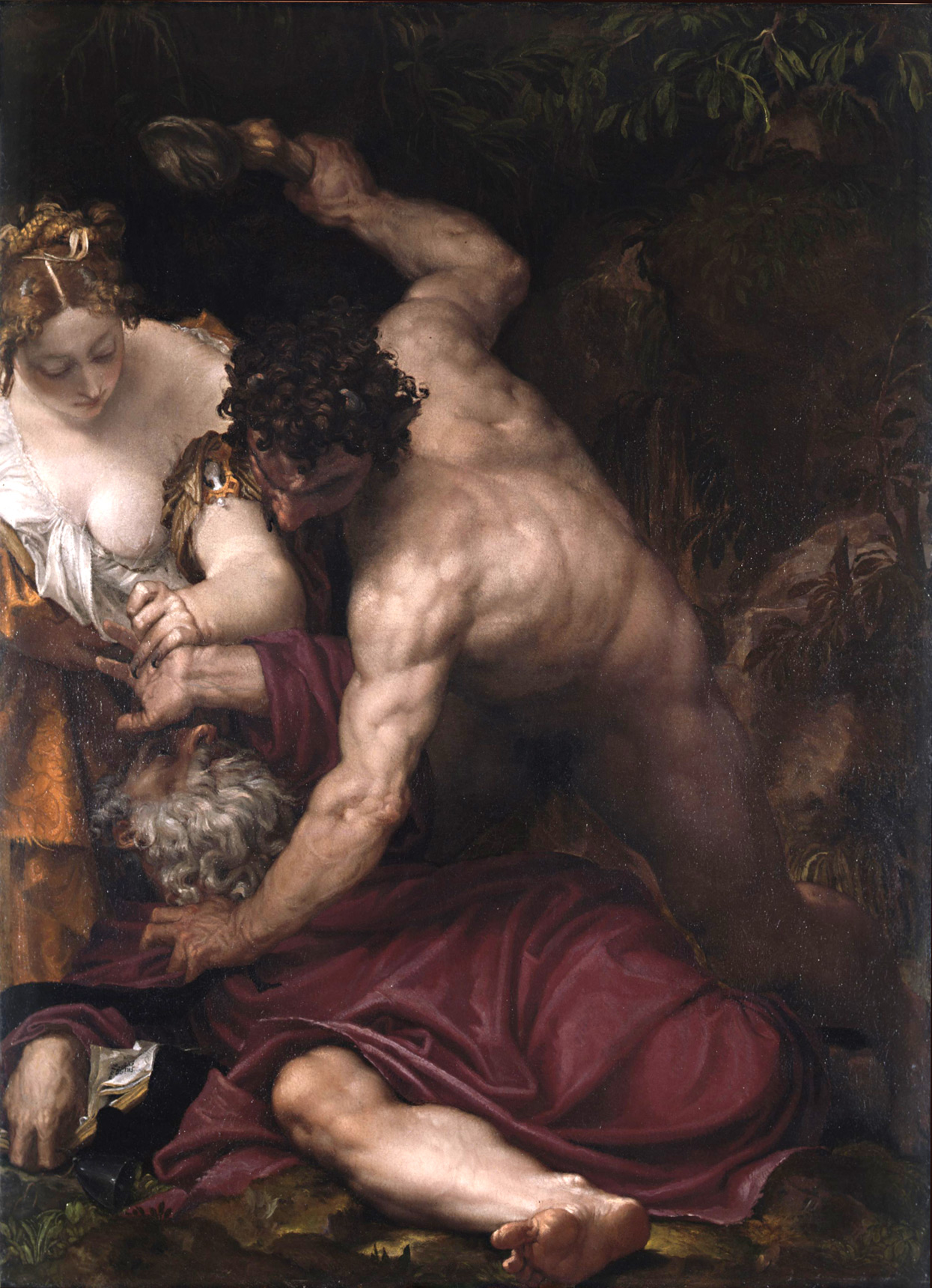
As some of you may know, last weekend I went to Paris with my mother for a brief but wonderfully refreshing trip. I knew before I even left that this post would be about one of the many paintings I would see at the Louvre. Technically, this version of St. Anthony isn't owned by the museum-- it's on loan for the unbelievably rich exhibition, Titian, Tintoret, Veronese: Rivals in Renaissance Venice, from the Caen Museum of Beaux-Arts.
Apart from the fact that I couldn't stop looking at this painting when I saw it, I wanted to write about it in contrast to a post I did about Michaelangelo's Torment of St. Anthony some three months ago. To contextualize a little, this one is Paolo Caliari Veronese's Temptation of St. Anthony (1553), and St. Anthony, of course, is the central figure with his two demons above him in human form.  In this post I don't want to talk about torment, or Michaelangelo (though he has definitely influenced the male body in this image), as much as I want to talk about how St. Anthony himself is a temptation for the artist in this image. What does it mean to immortalize the human moment in the figure of someone who has, in a sense, transcended himself? Is this truly a temptation or is this a figure so reduced in this moment that he prays not to his god, but pleads to his tempters? And lastly, is there a symmetry of some kind between the three figures, i.e. is it temptation and man that make a whole?
Not to digress, but a while back I read Borges' Conjectural Poem and in a conversation about it I came up with the notion that Heaven is, in a sense, a place where the good, vanquished from the battle on earth, go after they are defeated by earthly demons. And though I had forgotten about this reading of Heaven, I think this image of St. Anthony is brings it back. His body is right now that battlefield where the two demons are wrestling with their invisible enemies, faith and conscience. In each moment, with every blow it receives from the male demon, it also (if allowed) takes pleasure in the breast that hangs above it. The body of St. Anthony, then, receives each blow and is the conquered territory-- in a way it's all we have of the human saint, a body-battlefield, a body-torn, a body-in-agony.
Where is St. Anthony himself?
I want to answer this question in conjunction with one of my initial questions: is there a symmetry in the figures? Yes, there is a symmetry, a very curious one at that-- if we look carefully at the image, we'll see that there is a fourth human form in the painting, one that is made whole by parts of the three bodies of both the demons and St. Anthony. The female demon's breast, follows the exposed crotch of the male demon, which is then followed by St. Anthony's extended leg. There we have it, the human form from top to bottom. And in this whole human form we have St. Anthony, torn between gender, torn between body and soul, bible and breast. He is two-headed in order that he be tempted, while his third head exposes the agony of the body-battlefield.
This is Veronese's temptation: to represent the man who has transcended himself.  But how does one represent St. Anthony's particular brand of transcendence? There is sainthood, but this is a sainthood that splits itself amongst demons, and other earthly things. This is a sainthood that is saintly because while it pleads for resistance, it wants to know what it is that it resists, it touches the breast, it takes the blow, and in the same instant, it clutches the book.

Tuesday, November 24, 2009

For YL: Lecture notes, partie deux

Here is the second installment of lecture notes for the two lectures I gave for EK's Dante in English class. Delivering these lectures was one of the hardest but most rewarding things I have done in graduate school yet. I think I'm finally done with D, though I still have a draft with the last few lines of Paradiso-- and they're telling me that I know they're among the most beautiful lines of poetry ever written.


VITA NUOVA, PART II

•    Start with where we ended last time, and the figure of the old.
•    Love= misery, nosos, Cavalcantian view, there was no allegory in love.
•    Love in this way was non-transcendant. Today, we’re going to look at how it becomes T.
•    What didn’t get across last time: Love, no matter which one, still has a premise in physical beauty. Idea that dates back to Plato. How this physical beauty is processed is then dependent on the kind of love. If Beatrice= Medusa, this love, not happening. What enters for Dante is the essence of beauty, through Beatrice, and what enters for C. is love itself.
•    Purgatory XXX, pg. 368 and Beatrice’s reprimand. Fits in perfectly with this idea of Dante mistaking B in VN—Dante had a chance to benefit from her physical beauty and turn it into a spiritual love, but instead the D of the VN doesn’t understand and falls under the spell of Love and not B.
•    Purpose of lecture today: Arrival. We embarked from the old. By the end of the lecture we should be able to look back at the old from the view of the new. Dante arrives at the figure of Beatrice and love. To say the same thing in terms of the self: we’re journeying back to the pre-Lapsarian moment, after recognizing how we exist in the post-Lapsarian. To do this:
•    Vita Nuova, death of Beatrice, entrance of another feminine figure, look briefly at the Convivio, and then form an idea of Beatrice.
•    We’re going to do this in the following way:
1.    The presence of dreams and visions as suggestive of Prof. C’s idea that D had always been aware of the nature of B, and the love she represents—he just needed to understand it.
2.    Dante’s Boethian moment—and think of this as the moment of movement from his despair to salvation. Love can become transcendant. This is briefly visted in VN, so we’re going to talk a little bit about Convivio—interim work, not about B.
3.    And then arrive at the figure of B, and try to make a decisive statement. B as a secular figure. If there is time, we’ll take a quick look at how D was received by his peer, GC.
•    DREAMS: Beatrice’s death and the final VISIONS: (SHOW IMAGE). Try to form a hypothesis about how they relate to D’s greater idea of love.
•    Three dreams, conveniently to fit in with 3s that encompass B.  B and Love, eating the heart; the dream in which love instructs him to clear up his priorities and decide who it is he really loves; and the dream of Beatrice’s death.
•    Dream takes precedence over actual narration of he event. Prophetic nature of the dream. Often seen as religiously significant. Dream is prophetic, but its form becomes a means to express the literal, the non-allegorical love. This Love has a figure in the dream—D and L can communicate—interesting to think about how this old figure of Love has a space only in an unreal space—but what’s more interesting—how the nature of the dream changes in Purgatory, becomes prophetic, but also instructive. 
•    The dream of Beatrice’s death stands in utter contrast of the Purgatory dreams. Whereas they address the nature of the self, this one has a sense of the self obliterated, D is ruled by love, and on Pg. 623, wants to join B in death, in the bodily death, not realizing what he can do with the legacy she leaves him.
•    If the dream isn’t transformative, than what is? The vision. D borrows this from Boethius who in C of P has a vision of being visited by Lady Philosophy, and St. Augustine who in Confessions is moved to read the Bible when a mysterious voice speaks to him.
•    Two visions. The first, pg 645, in which D is reminded of HER, as opposed to of LOVE. Element of this vision, SHAME, the first stage in a conversion. First step towards being saved. Also first inkling that D is writing love poetry to a dead woman, something that Cav is not going to like. This is the vision in which D understands the utter disconnect he has, but because he feels shame, he can transform.
•    Second vision, pg 649, where we don’t know what he sees. But it goes along nicely with this idea of not knowing how to write either. In other words, only when he can see inside himself, will he be able to write about B.
•    Difference between a dream and a vision in VN: dream is prophetic, tool of the artist, means of representation. Vision completely rocks the text, and the world. It makes people take U-turns. Augustine. D on the road of love, feeding his body, makes a U-turn and heads back to the pre-lapsarian.
•    ON THE WAY to the pre-Lapsarian, there has to be something that will make love transcendent. Something that will make him understand the true nature of love. Comes in Section 35, pg. 640, The “gracious lady” or the “donna gentile,” who “has seen into the nature of my darkened life.” Crucial line. She had seen, and she makes him see. She makes three appearances and D doesn’t get it. Who is this woman?
•    Her story older than D’s and she is a reconfiguarion of Lady P. We’ve already seen Boethius in the Sphere of the Sun, along with St. Thomas Aquinas. B, 5th century Roman, charged with treason, finally executed, but during imprisonment wrote a work called Consolation of Philosophy. Last influence on Christian ethics. Lady P visits him moaning and groaning in prison. Over a series of sonnets and lectures, Lady P leads B back to himself and to God.
•    How Boethius mapped out existence? Four levels of existence, sensation, imagination, reason and divine. Humans on the level of reason.  One that what is in this world is material good. Often this material good isn’t controlled or reflective of our actions. But FREE WILL can help reach for a divine good, and go from the human level of reason to the divine. It is through the here and now that we can eventually be divine.
•    D’s Lady P—appears in moment of distress. Though her role is undeveloped in VN, D will devote an entire work to her—Convivio. Beatrice mentioned only once in C, because he still hasn’t found the words. Focuses on the “donna gentile” philosophy instead.
•    What is the gist of it? For one, it apologizes for the VN, calling it “fervid and passionate” and tells us that Convivio will be “tempered and mature.”
•    He also declares that it is inspired by Boethius because it is a desire to defend himself, he was in exile. And by Augustine, because he desires to spread virtue.
•    In the C, D tells us to love Philosophy, which in itself is a love of wisdom. When a human being loves wisdom, he is being the best earthly being he can be. And because this love of wisdom is an infinite process, once you have become the best earthly being, you transcend into harmony with the divine. Partially derives this idea from St. Thomas
•    Now this idea of being in dialogue with a divine creator isn’t purely Christian, it’s actually pretty flexible. St. Thomas—reconciled pagan philosophy with Christian ethics. Aristotle with the Christian world. Suggested that the two look for the same end, and can complement each other. Philosophy and theology are basically different starting points of getting to the same end, he argued, God. The nature of a human being, or the idea of goodness, can be explained both through religion, and through logic.
•    Other important St. Thomas idea, that allows us to read the Comedy as a book about the here and now, human soul is separate from the human body. Not to say that two have nothing to do with each other, but the soul is what makes the body a human body. When the body dies, the soul goes on living possibly. That’s how figures like Cunizza can make it to Paradise—because despite enjoying their sensuality, they don’t lose grip of their soul. She never loses her soul to Love, the independent figure. She is able to forgive herself, ie she knows she’s sinned and is willing to pay for it.
•    And now, finally, after these travels, we can arrive. WHO IS BEATRICE? 


(Dante Gabriel Rossetti, "Blessed Damozel")
•    Here’s the argument we’re going to make: She is constructed as a figure of Catholic salvation, but in truth, she’s deeply secular.
•    From the VN on, we’ve seen her surrounded by 9s and 3s. Explained in terms of the trinity. 9, prime number. There is the image of a pilgrim pg. 649.
•    Pg. 625, he has compared her to Christ. READ this Joan derives from John the Baptist, he who comes first, and she is Christ. This, to footnote, is still before he actually realized her meaning.
•    She is what we call a figure Christi or a Christ Figure. She dies for his salvation. She is not a saint, but she has come into her role of beatifier. 
•    What makes her secular with all this theology? She is Dante’s personal savior. Her numbers occur in relation to Dante—for example, she meets him at nine and then after nine years. She changes as he changes. Her narrative does not exist without his,
•    Later on, she chooses to take him through the three stages of the Comedy. Why Dante? Because in a way, she would not be Beatrice the beatifier without him, for she can only save the figure who loves her, not just anyone.
•    In other words, there is a Beatrice for everyone, if they are willing to find her. It isn’t necessary that she be the exact same as Dante is, just as Paradise is not the exact same as Dante imagines it to be. Beatrice’s nature as imagined, I think, more and more highlights the idea of Paradise as characterized by how each person in it sees it. In this life, the here and now, our actions must signify the desire to move up this path, to be looking for a connection with the divine, whether we do it by embracing our sensuality or whether we do it by defending the principles we stand for.
•    At this point of arrival, we have more symmetry, VN, Convivio, Comedy together also form a kind of trinity—the individual’s journey to his end goal.
•    LASTLY: If we float down to earth. Yes, in the VN, we have the new Dante writing in the old, the new converted Augustine calling the old Augustine a sinner, we have a confession which leaves the old D behind, but what does the Old think of the New?

•    Cavalcanti’s response: Sonnet XXIII
To Dante rebuking him for his way of life after the death of Beatrice
I DAILY come to thee uncounting times
And find thee ever thinking over vilely
Much doth it grieve me that thy noble mind
And virtue's plenitude are stripped from thee
Thou wast so careless in thy fine offending
Who from the rabble always held apart
And spoke of me so straightly from the heart
That I gave welcome to thine every rime
And now I care not sith thy life is baseness
To give the sign that thy speech pleaseth me
Nor come I to thee in guise visible
Yet if thou It read this sonnet many a time
That malign spirit which so hunteth thee
Will sound forloyn  and spare thy affrighted soul

For YL: Lecture notes, partie une.

One of my close friends, and earliest and most devoted readers of my blog told me that if I wasn't writings posts these last couple of weeks, I could at least put up the lecture notes for the lectures I was delivering on Dante's Vita Nuova.  I didn't take him seriously at first, but here you are Yukes, I think it's kind of a neat idea. They may not make much sense, but they're a wonderful memory.


VITA NUOVA
•    Moving back in Dante’s oeuvre, Vita Nuova is one of his early works, produced around 1293-94. This is twenty years before the Inferno, which 1314, and three years after the death of Beatrice Portinari.
•    Generally speaking, the Vita Nuova is a series of poems from Dante’s youth that he started writing for Beatrice nine years after he met her, and that are presented with prose explanation to us in the Vita Nuova. The poems, however, were written much earlier than the prose that accompanies them. When we read Vita Nuova then, this is something that needs to be kept in mind.
•    The Vita Nuova is also the only apparently biographical material we have on Dante’s life.
•    Over the next two lectures our goal is going to be to try and understand who exactly Beatrice is. Is she Beatrice Portinari, the actual woman who in Dante’s lifetime was married to someone else? Is she the muse of reason and philosophy inspired from earlier works such as Boethius’ Consolation of Philosophy? Or is she a figure created specifically in the tradition of medieval love poetry, who eventually becomes a central figure of Dante’s masterpiece, the Comedy?
•    The answer to these questions, I’m going to suggest in this lecture and next, lies in forming a conception of Love—and love as it is seen by Dante the poet. In other words, what we’re going to try and do is trace the process by which Beatrice becomes synonymous with love. It’s a process by which Beatrice transforms from Beatrice Portinari to the essence of what it means to be Beatrice, or one who can bless, and love transforms from the Lapsarian moment, professor C identified in his lecture to the pre-Lapsarian conception of love that Dante finally, finally achieves in Paradise.
•    In today’s lecture, we’re going to begin the journey towards the realization of Beatrice’s nature in the first three stages:
First is to have an understanding of what it means to have a Vita Nuova in the first place? How is the Vita Nuova, a new life? And in how many different ways can it be read as a new life? Of course, in order to have a complete understanding of the new, we have to be able to recognize what is it that has become old, what have we left behind, what are we rejecting?  And thirdly, what is it that has happened that has caused for this rejection to take place? What is the seminal moment that causes the rejection of the old?

Some basic ideas to keep in mind:
•    VITA NUOVA: poems from early in D’s career. Cavalcanti’s influence. Tradition of medieval love—secrecy, married lady, a lover who could also be married, Lancelot. Prose after B’s death. VN is pre-1290 and post-1290 text.
•    Phrase, Vita Nuova, never occurs in the text. Vita =Life. Nuova derives from the Latin novus, which can mean new, youthful, young, marvelous etc. D tells us he finds it in his “Book of Memory” which he intends to rewrite in the text we have today. Think about this?
•    But is this the New Life or the New New Life? 1. Beatrice 2. Understanding who Beatrice is. Love to Love as Salvation New life= Being a poet. New New Life= being a poet who reinvents poetry.
•    We will always be able to see VN as both New Life and New New Life, depending on the angle. If we take Dante the narrator’s than it’s just the New Life. If we take, Dante the man’s, from what we know historically, than it is the New New Life.
•    Also think of it as the “young life” for this is how the phrase appears in Purgatory XXX, line 116 (pg 368), Beatrice reprimanding Dante about wasting his Vita N. His “youthful life” or his “new life--” which seems to be a direct reference to the moment at which he sees her in the mortal world. And now it can mean yet another new life, where B because she has realized her role as a “Beatrice” or a blesser, can try to save him through her love.
•    One other way to think about—if we think in terms of the lecture on Tuesday—it is a book of return. In which case wouldn’t the title be an inversion? This last question we’re going to readdress in detail next Tuesday by thinking about it in terms of similar genres and works such as Boethius’ Consolation of Phil and Augustine’s Confessions.
•    We’ll get to these and Beatrice’s role of blesser in the next lecture. In this lecture what I suggest we do is establish a way to get to the new. What does it mean to have something new? What do we need to possess in order to have a new?
•    PAUSE
•    Need an old. An obsolete. That can no longer suffice. Old view of love, and old figure of Beatrice. What is the old view? Guido Cavalcanti. (SHOW IMAGE)


(Dante Gabriel Rossetti," Giotto Paints Dante's Portrait")
•    GC: Love= misery, loss of self, disaster, tears, an occupation of the rational part of the soul. The “beloved” mostly unimportant, just the medium that inspires love.

•    Donna me prega, ,
I
“Because a lady bids me I would speak/
Of an insubstantial thing that is so fierce
And  powerful it bears the name Love...
II
...Love is given shape by a darkness born of Mars
---it takes a sensate name/
It enters when an object caught by sight/
Takes up in the potential intellect.

•    What is this poem saying? He has been inspired by a woman. Love and sight, physical desire, the senses. This is literally what he means. No allegory in his poems.
•    Who have we already met as Cavalcantian lovers? F and P. Love enters through their eyes. And it takes over their minds.
•    But what F and P do in Canto V, D also does to a degree in his poetry.
•    Character called love= first poem, 592. (LOVE IMAGE)
•    597, imitating love
•    598, love begins to fuse with him
•    Here is perhaps the reason Dante faints when he meets them. His love too is physical.
WITH THIS IN MIND, we can ask the question, WHO IS BEATRICE THAN?
•    There are a number of ideas on this. Erich Auerbach has suggested she probably didn’t exist. She could have been the typical Florentine lady. Or she could have been what D made her out to be. But given historical circumstances like different marriages, his exile, her early death etc. probably more made up than anything else.
•    Let’s see what he tells us in the biographical information: they meet when they are nine, he falls in love with her, (GARDEN IMAGE) nine years later, she acknowledges him one day, he sees this as a reason to go on, but then, given that he tries to protect her virtue by going after other women, she is offended and refuses to acknowledge him. And then she dies. 


(Henry Holiday, "Dante and Beatrice" 1883)
•    And what does he tell us in his poems?
•    Well actually very little. Most of his pre-B death poetry is about love, not her so much.
•    Pg 606, B as the typical coquettish mistress (her rejection, show WEDDING IMAGE)
•    Pg 615, physical being that she is
•    Pg 616, back to the gaze, the eyes, the love transformation of Cavalcanti
•    And that’s all really.
•    We’re back at the question, WHO IS BEATRICE?
•    Here’s my answer: The earthly Beatrice is no one significant, in fact, I want to argue that she is a symbol left in by Dante to serve as a comparison to the true Beatrice. She is just the representative of Cavalcante and Guinizelli and Dante’s predecessor poets and their tradition.
•    When we read Beatrice like that, the VN is very much both a text of inversion, and of reinvention. It is the text in which D starts the trend for a return to the pre-Lapsarian moment, the old moment, one won’t be completed till the end of Paradise. But it is also very very new, because in this we have the Dante of old, arriving at the juncture of the New Dante—Boethius, and St. Augustine. 


(All page numbers correspond to Mark Musa's A Portable Dante, Penguin, 2003)

Monday, November 9, 2009

Pagans and Monsters and Epics! Oh my!

"So Grendel waged his lonely war,
inflicting constant cruelties on the people,
atrocious hurt. He took over Heorot,
haunted the glittering hall after dark,
but the throne itself, the treasure-seat,
he was kept from approaching; he was the Lord.
These were hard times, heart-breaking
for the prince of the Shieldings; powerful counsellors, 
the highest in the land, would lend advice,
plotting how best the bold defenders
might resist and beat off sudden attacks.
Sometimes at pagan shrines they vowed
offering to idols, swore oaths
that the killer of souls might come to their aid
and save the people. That was their way,
their heathenish hope; deep in their hearts
they remembered hell. The Almighty Judge
... was unknown to them."


I've changed gears from Homer to another great "epic" poet, the anonymous composer of Beowulf. I was debating trying my hands at Boethius earlier tonight, but somehow the reason and passion just weren't cutting it for me. So here's a piece that is without both-- it exemplifies what it means to be without rationality, and, in a sense, without passion as well. I want to say a couple of things to contextualize the passage and then come back to some of the ideas I may have about it: the poet, it seems, belongs and identifies with a Christian world, but places his narrative in a pre-Christian land. At the same time, because his meter is not without ideas of salvation and divine justice, I see it as essentially layered with both the pagan and Christian tradition.
To come back to the passage at hand though-- we're still early in the poem, Grendel the monster who will eventually be destroyed by Beowulf is at large, and the Danes, a pagan people, are existing in a kind of a reflex, begging for salvation in the face of destruction. There seem to be a number of things going on here, but I want to focus on this idea of a "lonely war." Indeed, what does it mean for Grendel to be alone? But what does it mean for the "Shieldings" or the people of the epic to be alone? If Grendel ravages alone because of his ancestor Cain, who are the Danes at this particular moment, a people who are deeply alone because of their singular disconnect with the narrator? It's a slightly complex thought, but this is how I see this passage as exemplifying the Danes as a more lonely people than a monster like Grendel: Grendel has an ancestry that connects him to Cain, the biblical figure who murdered his brother and became the father, at least according to our poet, of giants, elves, and other evil phantoms. The Danes, on the other hand, are not given this genealogy. Without doubt, they are under the watchful eye of the poet's god who watches over them and keeps Grendel from the throne, but they have other gods, idols to whom they pray and sacrifice, but not the god of Grendel and the poet. In other words, the question this passage raises is what does it mean to be saved by a god who is not your own? What does it mean for a people to be a narrated by a poet who dismisses "their way, their heathenish hope."
If the Danes are a people who do not know their creator, does Grendel know his? Is Grendel, through a clear ancestry, somehow closer to the narrator's God than the Danes, the people who will be saved, are? Of course, the whole poem can be read as a Christian allegory, but what's at stake here is at the level of narrative. Grendel's loneliness surely lies in his evil, but the lonely battle fought by the Danes is explained by the disconnect of their being from the narrative itself. I don't usually like to bring the theoretical into this blog, but I want to quickly mention Mikhail Bakhtin, the Russian theorist, who sees the epic as separate from the novel in the way that it has only one view of the world. The poet and his people are one, as Homer was one with the warriors and the travellers, and as Virgil was one with Aeneas and his people. In this passage, there are two voices, maybe three. There is the voice of Grendel, branched off from God's creation through Cain, there is the voice of the narrator, convinced of the presence of the Christian god, and there is finally, the voice of the Danes, broken but still speaking of what it knows to be familiar, what it thinks can save these beleaguered people.
I want to end with coming back to the first stanza. Grendel is being kept from the throne by "the Lord." The battle, and I don't want to do a Christian reading here, is being fought between a creator and a descendant of the figure who threatened creation. What is keeping Grendel from the throne is indeed an invisible force, but this force, I think, occupies the level of the narrative as well. It's possible because the narrator is, in a way, closer to Grendel than he is to the Danes. Grendel is not a pagan outside of Christian discourse all together, in fact he is very much a part of it. Perhaps, then, I should take back my argument about three world views and shear it down to just two. Grendel and the narrator vs. the Danes.

(Beowulf, translated from the Old English by Seamus Heaney. Image: the first page of the original Beowulf manuscript, courtesy The British Library)

Monday, November 2, 2009

Penelope: twisting and turning.


"...Her very words,
And despite our passion and pride, we believed her.
So by day she'd weave at her great and growing web--
by night, by the light of the torches set beside her,
she would unravel all she'd done. Three whole years,
she deceived us blind, seduced us with this scheme...
Then when the wheeling seasons brought the fourth year on
and the months waned and the long days came round once more,

one of the women in on the queen's secret told the truth
and we caught her in the act-- unweaving her gorgeous web."


(Homer: The Odyssey, Book 2, translated by Robert Fagles.)

This is that one point in the Odyssey where I often wonder whether it's an epic about the travels of the man of "twists and turns" or whether it rests on the moment when Penelope becomes a force that drives the narrative. Not Neptune, not the wily Odysseus, but Penelope. In other words, can we read the Odyssey as the story of a going, not a coming? Is it the story of Odysseus coming home or is it story of Penelope whose last stronghold has collapsed and who must, therefore, venture forth in order to save herself?
Here Penelope does not speak, but is spoken about-- by the suitors who have collected in the palace and who wait impatiently for her to finish weaving Laertes' burial shroud. They have been kept at bay, circling, waiting, until this tapestry that will never end is ended, and the husband she waits for is no longer awaited, and until her faith is unfaithful. This is the information that will launch Telemachus's ship and lead, in a way, to Odysseus's successful return to Ithaca. Penelope, then, inspires both speech and action in the Odyssey--something that is almost directly opposite of Chryses in the Iliad, whose presence brings silence and destruction and of Dido in the Aeneid, whose realm is a point of departure, not of arrival.
Yet, for the suitors, Penelope is none of these things-- in fact, she's almost a kind of Circe, who also weaves for the sake of deception. She doesn't turn the suitors into pigs, but in a way, the tapestry is more human for her than these unwelcome visitors are. So what  do we make of her, this woman who weaves desperately to prolong her state of being and belonging? She is very much the wife of Odysseus, twisting and turning even as the "gorgeous web" takes form. But she is also the figure of self-preservation in the epic whose lie is for herself, her son, and her husband. Does she lie really, or does she just never bring herself to a point of speech? Or does she do something more complex than anyone else in the narrative by using an art form to speak for her? I think what Penelope does then should be read as a form of preserving being not only in the sense of her bond with Odysseus and Telemachus, but also as a form of preserving her bond with herself-- she transfers her narrative to the art form, something that can never be interpreted definitively.
The image up there is Joseph Wright of Derby's "Penelope Unravelling her Web," (1784). I've chosen it because of how perfectly it makes the case-- Odysseus in the background, Telemachus in the front-- her past and her future, and her ball of wool in her hand as a kind of weapon of preservation, as something that can both encapsulate what has happened, and prolong what is to be until it can be the way it should be. Until then, she will weave her own version of time.

Sunday, October 25, 2009

See through my eyes.


"He also told Don Quixote that in his castle there wasn't any chapel where he could keep the vigil of arms, because it had been demolished to build a new one, but he knew that in case of need, vigil might be kept anywhere and Don Quixote could do so that night in a courtyard in the castle..."
"... Don Quixote promised to do exactly as he'd been told and then was given orders to keep the vigil of arms in a large yard on one side of the inn; and he gathered his armour together and placed it on a water-trough next to a well, and taking up his leather shield and seizing his lance, he began with a stately bearing, to pace back and forth in front of the trough; and as his pacing began night was beginning to fall." --- Miguel de Cervantes, Don Quixote (Book 1, Chapter 3, translated by John Rutherford)


(Gustave Doré, Don Quixote Guards his Armour)

I've chosen this passage from Don Quixote, not because it ever stood out for me in my readings, but because I fell deeply in love with Doré's rendition of the scene. We have a lonely old man, and his makeshift sword pointing upwards towards the moon, upwards as it always does, a full moon up above, and an armour sitting atop a stage that serves beasts by day. What struck me in the image was the exquisite loneliness that is embodied in Don Quixote's person-- a loneliness that is so beautifully portrayed by the artist who understands how thin the old man must be, yet how regally he holds his probably aching back, and how graceful his poise remains as he extends his lance to threaten any and all who come for his armour and his honor.
In the text, of course, Don Quixote is performing the vigil that is the final task he must fulfill before being knighted by the innkeeper, yet, when I see this image, I wonder to myself whether that is exactly what he's doing. So what I'd like to do in this post is to somehow try to envision vision-- what Don Quixote's sees within and outside himself, and how the reader-artist sees his figure. Don Quixote, I would think, is an artist in himself, only the images and sounds he is able to produce remain within his mind and are enunciated in his speech and actions. In other words, what Don Quixote sees and does is directly a response to a reimagining that takes place in his mind. As a character in the text, he behaves in accordance with his own narration rather than that of a narrator's. Windmills, then, become giants taken almost directly out of the Inferno. A humble inn becomes a castle. Friars become enchanters abducting a princess. In an earlier post, I called Don Quixote, "the reader;" in this one, I'd like to call him "the writer." His figure is of the artist who having read everything turns to produce his own art-- an art that comes to us in what his friends and neighbours see as madness.
But if Don Quixote's art is visible in only in his performance, or possibly in his knowledge that he is being written, what does Doré's image tell us about our own limits. I think it tests our limits in all kinds of ways, actually. For one, I was reminded more than anything else of Pygmalion praying that his statue come to life. I had all kinds of ideas floating in my head about the armour as a kind of ghostly lover that accompanies Don Quixote throughout his travels. More importantly, though, I think Doré's image puts forward a fascinating match between madness and the right not be mad. The full moon represents so much more so Don Quixote's mental infirmity in the real world, but the lance that extends outward almost threatening the moon is the madness that knows itself.
As I see this post, it says two almost oppositional things in the same vein-- there is the idea that Don Quixote is essentially a lonely figure whose incredible belief in his self renders him the subject of an image so potent. And then we can read him as a figure on par with Cervantes, guiding the text through an eye that reenvisions what it sees; and as a figure who, particularly, in the image dares for there to be a greater insanity than his own.
Cervantes has never been one of my strengths when it comes to reading, so if this post comes of as somewhat incoherent, it's because I had a conversation with my friend AR earlier today where she told me that this text makes her want to be better at Spanish-- and that inspired me to give Cervantes another shot. I don't think there's any higher compliment one can pay a writer, so here's to hoping I've done some justice to C, to DQ... and to A.