Showing posts with label The Renaissance. Show all posts

Thursday, April 26, 2012

So many St. Jeromes...

Almost three years ago now, I got to see Bassano's St. Jerome penitent up close at the Louvre as part of the breathtaking "Titien, Tintoret, Veronese: Rivals in Renaissance Venice" exhibit. In an earlier post, I wrote about Veronese's Temptation of Saint Anthony, here's another saint, one I know a lot less about and who, at least at a first glance, seemed considerably less exciting than St. A. When thinking about what text this post would be about earlier this afternoon, I did a lot of flipping of pages, some quick glancing at Montaigne's Essays, but nothing seemed to click until I remembered that my little souvenir album of the exhibit still had much to offer. As in so many of my other posts, I "read" this painting in terms of a conversation I had just today, about faith, this world, oneself, the individual, and as I will explain in a moment, Bassano's depiction of the penitent Saint, and not Titian and Tintoret's made sense.
Here is Titian's repentant St. Jerome to the left, and Tintoret's on the right:
St. Jerome's story, if it makes things any clearer, is of a man who partook liberally of the pleasures of life, repenting periodically, and then repeating the same until he took up a permanently ascetic existence, one that led him through Antioch (or present day Turkey), and then into Chalcis (or what we know as the Syrian desert area). His spiritual and physical journey was also an intellectual one, and Jerome became known for his knowledge of Hebrew, and his translations of the Hebrew Bible in Greek. My interest is in his penitence, the active regret he felt for his sin, depicted so beautifully by these three Venetian artists. Before turning to Bassano, I want to take a quick look at Titian and Tintoret's Jeromes. Clutching the stone he uses to punish himself, unmindful of the book in his hand, Titian's Jerome gazes directly at the crucifix, half-prostrated, yet unconscious of his own posture, supported by his own deeds (symbolized by the lion's head engraved into the rock). Tintoret's, interestingly, is almost an inverse--larger in proportion, agent, he holds the cross loosely, away from himself, his gaze focused directly on the pages before him. The landscape, unlike Titien's ravaged scene, is discernable; the lion is guarding, rather than supporting, his figure. Despite this inversion, however, what the two versions of Jerome share is the purpose of their subjects, that is to say, each painting offers a source or center through which Jerome repents. In the first, it is the figure of Christ on the cross, and in the second, it is the gospel or the word of Christ.

But what about Bassano's Jerome? His eyes are totally out of focus--the crucifix is well above his glazed line of vision, and his books have fallen from his lap. He's holding on to his stone, yet his arm his hardly poised to strike. The lion's head is replaced with a human skull that sits across from an hourglass, so many signs of mortality, of a worldliness that is absent from Titian and Tintoret's works. In other words, Bassano's Jerome though prepared for repentance, cannot seem to get it right, that is to say, the crucifix sits unseen, and the gospel unread, while Jerome gazes at nothing in particular, his furrowed brow suggesting a complexity of thought that cannot reconcile with the simplicity of penitence. I may be getting it all wrong in saying that Bassano's Jerome isn't repentant at all, and that he is, in fact, furiously contemplating the nature of this act of worship. He is bodily in a way that the other two are not, placed almost at par with Christ on the cross, Jerome here just doesn't get it. Yet, in the conversation I mentioned earlier (incidentally with a dear friend who has not for the first time inspired this blog) there was a moment in which the problem of reconciling faith with the nature of the world we live in now came up--how can my faith explain all of this, is the question I think Jerome is asking as well. How can the word or the symbol of faith, repentance, forgiveness, love, humanity etc. make sense in my particularly troubled world, this figure seems to suggest. The beauty of this scene, and what draws me to it, is precisely the unanswerability of the question. We can keep looking, and Jerome will not stop thinking, and we'll wait because he's on the brink of figuring it all out.

Saturday, December 5, 2009

Temptation, encore.


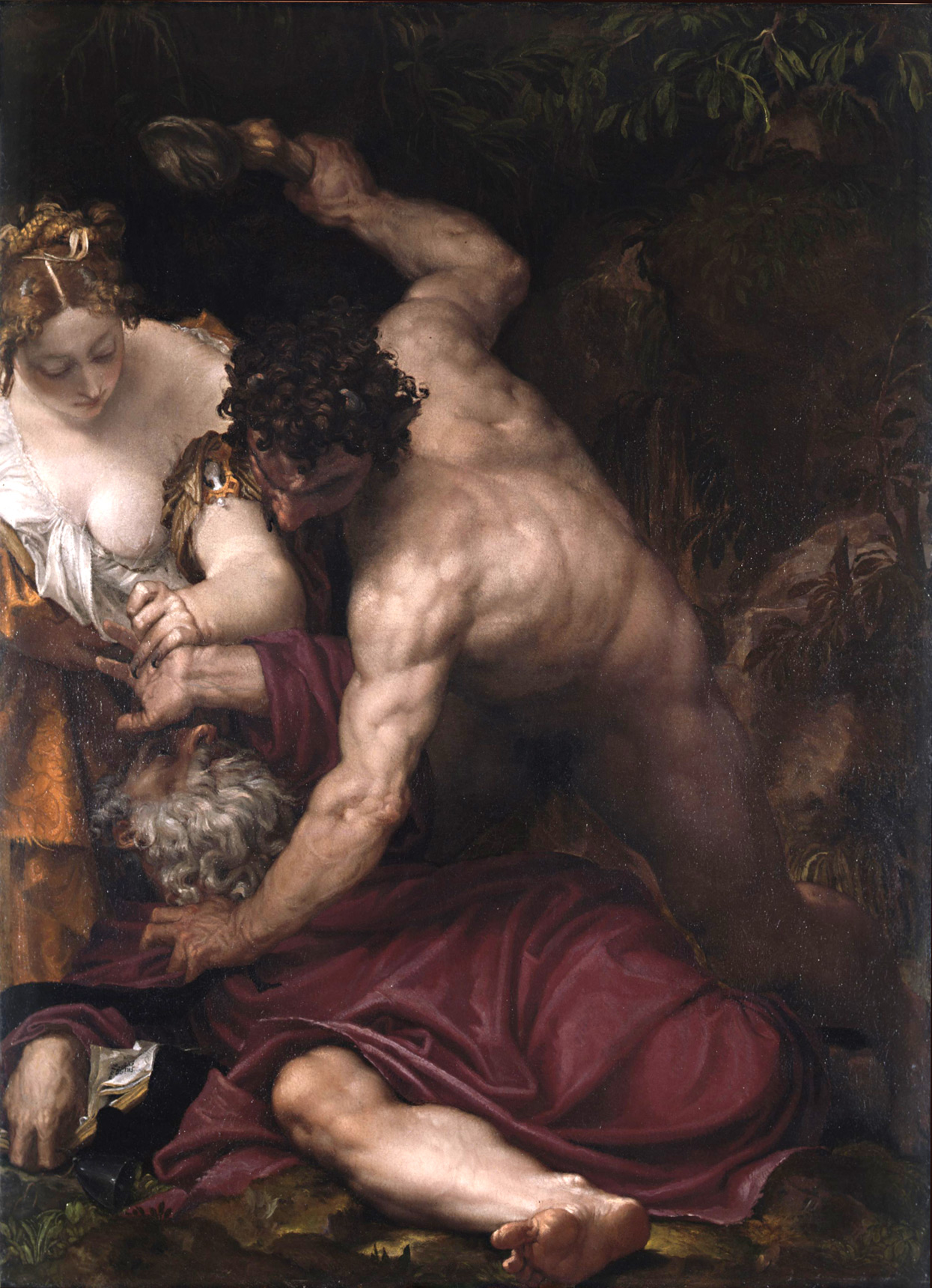
As some of you may know, last weekend I went to Paris with my mother for a brief but wonderfully refreshing trip. I knew before I even left that this post would be about one of the many paintings I would see at the Louvre. Technically, this version of St. Anthony isn't owned by the museum-- it's on loan for the unbelievably rich exhibition, Titian, Tintoret, Veronese: Rivals in Renaissance Venice, from the Caen Museum of Beaux-Arts.
Apart from the fact that I couldn't stop looking at this painting when I saw it, I wanted to write about it in contrast to a post I did about Michaelangelo's Torment of St. Anthony some three months ago. To contextualize a little, this one is Paolo Caliari Veronese's Temptation of St. Anthony (1553), and St. Anthony, of course, is the central figure with his two demons above him in human form.  In this post I don't want to talk about torment, or Michaelangelo (though he has definitely influenced the male body in this image), as much as I want to talk about how St. Anthony himself is a temptation for the artist in this image. What does it mean to immortalize the human moment in the figure of someone who has, in a sense, transcended himself? Is this truly a temptation or is this a figure so reduced in this moment that he prays not to his god, but pleads to his tempters? And lastly, is there a symmetry of some kind between the three figures, i.e. is it temptation and man that make a whole?
Not to digress, but a while back I read Borges' Conjectural Poem and in a conversation about it I came up with the notion that Heaven is, in a sense, a place where the good, vanquished from the battle on earth, go after they are defeated by earthly demons. And though I had forgotten about this reading of Heaven, I think this image of St. Anthony is brings it back. His body is right now that battlefield where the two demons are wrestling with their invisible enemies, faith and conscience. In each moment, with every blow it receives from the male demon, it also (if allowed) takes pleasure in the breast that hangs above it. The body of St. Anthony, then, receives each blow and is the conquered territory-- in a way it's all we have of the human saint, a body-battlefield, a body-torn, a body-in-agony.
Where is St. Anthony himself?
I want to answer this question in conjunction with one of my initial questions: is there a symmetry in the figures? Yes, there is a symmetry, a very curious one at that-- if we look carefully at the image, we'll see that there is a fourth human form in the painting, one that is made whole by parts of the three bodies of both the demons and St. Anthony. The female demon's breast, follows the exposed crotch of the male demon, which is then followed by St. Anthony's extended leg. There we have it, the human form from top to bottom. And in this whole human form we have St. Anthony, torn between gender, torn between body and soul, bible and breast. He is two-headed in order that he be tempted, while his third head exposes the agony of the body-battlefield.
This is Veronese's temptation: to represent the man who has transcended himself.  But how does one represent St. Anthony's particular brand of transcendence? There is sainthood, but this is a sainthood that splits itself amongst demons, and other earthly things. This is a sainthood that is saintly because while it pleads for resistance, it wants to know what it is that it resists, it touches the breast, it takes the blow, and in the same instant, it clutches the book.

Sunday, October 25, 2009

See through my eyes.


"He also told Don Quixote that in his castle there wasn't any chapel where he could keep the vigil of arms, because it had been demolished to build a new one, but he knew that in case of need, vigil might be kept anywhere and Don Quixote could do so that night in a courtyard in the castle..."
"... Don Quixote promised to do exactly as he'd been told and then was given orders to keep the vigil of arms in a large yard on one side of the inn; and he gathered his armour together and placed it on a water-trough next to a well, and taking up his leather shield and seizing his lance, he began with a stately bearing, to pace back and forth in front of the trough; and as his pacing began night was beginning to fall." --- Miguel de Cervantes, Don Quixote (Book 1, Chapter 3, translated by John Rutherford)


(Gustave Doré, Don Quixote Guards his Armour)

I've chosen this passage from Don Quixote, not because it ever stood out for me in my readings, but because I fell deeply in love with Doré's rendition of the scene. We have a lonely old man, and his makeshift sword pointing upwards towards the moon, upwards as it always does, a full moon up above, and an armour sitting atop a stage that serves beasts by day. What struck me in the image was the exquisite loneliness that is embodied in Don Quixote's person-- a loneliness that is so beautifully portrayed by the artist who understands how thin the old man must be, yet how regally he holds his probably aching back, and how graceful his poise remains as he extends his lance to threaten any and all who come for his armour and his honor.
In the text, of course, Don Quixote is performing the vigil that is the final task he must fulfill before being knighted by the innkeeper, yet, when I see this image, I wonder to myself whether that is exactly what he's doing. So what I'd like to do in this post is to somehow try to envision vision-- what Don Quixote's sees within and outside himself, and how the reader-artist sees his figure. Don Quixote, I would think, is an artist in himself, only the images and sounds he is able to produce remain within his mind and are enunciated in his speech and actions. In other words, what Don Quixote sees and does is directly a response to a reimagining that takes place in his mind. As a character in the text, he behaves in accordance with his own narration rather than that of a narrator's. Windmills, then, become giants taken almost directly out of the Inferno. A humble inn becomes a castle. Friars become enchanters abducting a princess. In an earlier post, I called Don Quixote, "the reader;" in this one, I'd like to call him "the writer." His figure is of the artist who having read everything turns to produce his own art-- an art that comes to us in what his friends and neighbours see as madness.
But if Don Quixote's art is visible in only in his performance, or possibly in his knowledge that he is being written, what does Doré's image tell us about our own limits. I think it tests our limits in all kinds of ways, actually. For one, I was reminded more than anything else of Pygmalion praying that his statue come to life. I had all kinds of ideas floating in my head about the armour as a kind of ghostly lover that accompanies Don Quixote throughout his travels. More importantly, though, I think Doré's image puts forward a fascinating match between madness and the right not be mad. The full moon represents so much more so Don Quixote's mental infirmity in the real world, but the lance that extends outward almost threatening the moon is the madness that knows itself.
As I see this post, it says two almost oppositional things in the same vein-- there is the idea that Don Quixote is essentially a lonely figure whose incredible belief in his self renders him the subject of an image so potent. And then we can read him as a figure on par with Cervantes, guiding the text through an eye that reenvisions what it sees; and as a figure who, particularly, in the image dares for there to be a greater insanity than his own.
Cervantes has never been one of my strengths when it comes to reading, so if this post comes of as somewhat incoherent, it's because I had a conversation with my friend AR earlier today where she told me that this text makes her want to be better at Spanish-- and that inspired me to give Cervantes another shot. I don't think there's any higher compliment one can pay a writer, so here's to hoping I've done some justice to C, to DQ... and to A.

Sunday, October 18, 2009

Now show me something pretty.

"... they saw that dawn had already come to the east, with the beauty and color of a rose, and all the stars had been scattered, save only the lovely mistress of Heaven, Venus, who guards the confines of night and day. From there, there seemed to come a delicate breeze, filling the air with biting cold, and among the murmuring woods on nearby hills wakening the birds into joyous song." -- The Book of the Courtier, Baldassar Castiglione (translated by George Bull).

"And first of all Aristophanes dropped off, then, when the day was already dawning, Agathon. Socrates, having laid them to sleep, rose to depart; Aristodemus, as his manner was, following him. At the Lyceum he took a bath, and passed the day as usual. In the evening he retired to rest at his own home.
Symposium, Plato (translated by Alexander Nehamas).

Tonight, I'm going to blog about sunrise. Given the intense nature of my last post, I think this week is for things-that-are-not-infernal (though I might break my pledge about not doing more D). The first excerpt is from the ending of a famous Italian Renaissance text called the Book of the Courtier-- a group of courtiers, men and women both, sit with their Duchess and discuss what form and practice the ideal courtier should take. The second excerpt is from the Symposium, a text by Plato, in which a group of men, attended to by women, sit, drink, and discuss the ideal forms of love. There are various similarities between the two texts, but the one that interests me most, and that stood out for me even as a college freshman is the use of sunrise, dawn, a new day to mark conclusion. A month or two after reading The Courtier, I was to read Madame Bovary (all in the much-beloved HUM Sequence at Princeton), and this time I would see sunrise on the occasion of Emma's funeral, and once again, it would hit me-- why a new beginning at the point of ending?
As a freshman, I had various theories about this, dawn as a metaphor for gender reversals, dawn as a device for peripeteia in texts that wish to either imitate or parody the classical tradition etc. Right now, I want to put forward a simpler reading: something has gone horribly awry in these texts right before the moment at which they are meant to end; something that when written has become problematic. The richness of dawn and possibilities of a new today, then, are devices meant to soothe not only the reader, but also this very perturbed text. True enough, in the Book of the Courtier, an argument on the abilities of women to love had just begun, in the face of the court's duchess. In the Symposium, Socrates has just rejected the advances of his friend Alicibiades whose speech on love only confirmed and elaborated upon his own. I don't want to write too much about Madame B. just yet, but indeed, her death, though coming, is both disturbed and disturbing.
Sunrise, I am inclined to think at this moment, would not be a necessary element of the text if it had progressed without rupturing so close to its conclusion. This idea of a text's rift with itself, of course, gives birth to a thousand other questions--why would an author not be careful? why should he lack divine control over his creation etc.? There are several answers to this one-- the text could be based in reality (as has been argued in the case of the Symposium), or the text wants to have a kind of reality and is still not mature enough to handle it, or that the author himself craves dissonance the size of a tiny tragedy-- too small to be noticed, small enough to be painted over with shades of daybreak.
Of course, we have two completely different kinds of text-soothers here. The Renaissance sunrise is highly stylized, and deeply sensual. Socrates' sunrise, on the other hand, lasts only a second. But it marks his decision to normalize, to spend a day in the baths, in his home, in the lap of the ordinary rather than a night orchestrating the battle between eros and philos. They are both equally relevant here, however, because they both give rise to the idea that light, new days, baths, and breezes can somehow fix the mistakes of the night before. A day spent in the intense beauty of the ordinary is somehow required for the mortal who has stumbled briefly while testing his limits. In other words, the bodily and the earthly are very much a part of the spiritual and the ethereal. And sunrise, as often as we sing, paint, write and dance about it, is deeply ordinary, the beautifully ordinary.


P.S. I couldn't resist an image for a post about something so often painted. Up there is Aurora Taking Leave of Tithonus (Franceso Solimena, 1704, Getty Museum)-- in other words, the dawn goddess taking leave of her Trojan lover. I am not quite sure how it informs the argument I've just made, but it's something worth thinking about.

Saturday, September 26, 2009

Inversion.

"The Tragedy of Hamlet, Prince of Denmark"

SCENE I. Elsinore. A platform before the castle.

FRANCISCO at his post. Enter to him BERNARDO
BERNARDO
Who's there?
FRANCISCO
Nay, answer me: stand, and unfold yourself.
BERNARDO
Long live the king!
FRANCISCO
Bernardo?
BERNARDO
He.
FRANCISCO
You come most carefully upon your hour.
BERNARDO
'Tis now struck twelve; get thee to bed, Francisco.
FRANCISCO For this relief much thanks: 'tis bitter cold,
And I am sick at heart.

Across the continent and on the island for the first time: here's one from the Bard. But first, I want to quickly explain why I've chosen this particular passage for tonight: events in and around my life have curiously enough reflected a conversation I had with one of my professors this last Thursday. During coffee and Dante-housekeeping, he suddenly referenced the opening of Hamlet and noted that there is something terribly awry in the scene that presents itself. As an opening scene it does much to reflect the disorder that will follow in the play for at this point, it is not the guard who asks "who's there" but the apparent passer-by. Yet, while thinking about this scene right now, I am thinking of sheer uselessness of prophecy and warning-- do we ever read the signs to begin with?
This question sequence is a fascinating one though; "Who's there" says Bernardo who has just entered upon Francisco's guard. Francisco's reply "nay, answer me," however, is uncanny-- suggesting almost as if an exchange unknown to audience or reader has taken place already. This, of course, is yet another reflection of the events to follow-- there will be events and conversations that take place without Hamlet's knowledge. This exclusion of his figure from the events of the play make him resemble, strangely enough, us, the readers or audience who watch and read, but emerge finally without much knowledge of what has occurred.
I wonder if inversion comes hand-in-hand with a loss of the self. Bernardo's self-identification is his loyalty to the King of Denmark, and by his attachment to the hour of midnight. He is not Bernardo, but rather the King's servant and the midnight guard. He begins after the day ends. In other words, he is someone who is not himself-- in fact, perhaps we can say that he hails the spirit of inversion and chaos that not only characterizes Hamlet, but is also seen in other Shakespearan tragedies, Romeo and Juliet and King Lear (I just cannot forget the scene of Cordelia carrying her aged father) being among them.
Now to come back to the question I asked at first, what does it mean to have a sign in the first place? Is the sign or the prophecy just a privilege of the author, and a trick that is played upon the reader? There are several things at play here I think-- yes, the sign is most likely something the author wants to show off with, but it may well be also something that is completely unimportant. What I mean to say here is that the sign enters at the very beginning of many Shakespearan and sometimes even Greek plays, precisely because the beginning is the point that no one cares about, that audiences fail to hear, and that readers tend to dismiss. Who cares whether Benvolio and Tybalt fight at the beginning-- this is a supposed to be a play about lovers? Who care whether the guards are babbling nonsense on a cold night-- isn't this play about a royal family? The unimportant place of the sign is then, I think, an awful reflection on human nature itself, on its optimism, its perseverance, and its inability to admit defeat until the benign sign is suddenly the unleashed beast.

Tuesday, September 8, 2009

The man himself.

"This great world which some do yet multiply as several species under one genus, is the mirror wherein we are to behold ourselves, to be able to know ourselves as we ought to do in the true bias. In short, I would have this to be the book my young gentleman should study with the most attention. So many humors, so many sects, so many judgments, opinions, laws and customs, teach us to judge aright of our own, and inform our understanding to discover its imperfection and natural infirmity, which is no trivial speculation. So many mutations of states and kingdoms, and so many turns and revolutions of public fortune, will make us wise enough to make no great wonder of our own. So many great names, so many famous victories and conquests drowned and swallowed in oblivion, render our hopes ridiculous of eternizing our names by the taking of half-a-score of light horse, or a henroost, which only derives its memory from its ruin... Pythagoras was wont to say, that our life resembles the great and populous assembly of the Olympic games, wherein some exercise the body, that they may carry away the glory of the prize; others bring merchandise to sell for profit; there are, also, some (and those none of the worst sort) who pursue no other advantage than only to look on, and consider how and why everything is done, and to be spectators of the lives of other men, thereby the better to judge of and regulate their own." From "Essais," by Michel de Montaigne, translated by Charles Cotton.

Last Sunday, a now very repentant friend stood me up for brunch by mistake. Too far from the townhouse on the UES where I'm spending my last few weeks of summer, I decided to do something I haven't done or been in a while-- hang out solo until my next scheduled rendezvous. Chelsea Market is my new favorite Manhattan spot so I took myself there, bought myself a New Yorker and sat down at Ronybrook Farm's Milk Bar (again) for a lovely breakfast involving raisin-walnut bread, cinnamon butter, and a mysterious egg-in-a-hole, and of course, quelques tasses du cafe. I could have bought Vanity Fair or Harper's but the New Yorker took my breath away with the fact that there was an article on Michel de Montaigne hiding within. What better date for a quiet morning with oneself than the man who invented the very concept?
In her article
Jane Kramer picked up on the very best of Montaigne-- his struggle to know himself and how exactly this plays out in his essays. In this post though, I want to move away from that and examine an excerpt where Montaigne engages briefly with the route to selfhood: it's from "Of the Education of Children," and M talks at length about the schooling of a young boy. This passage is kind of special for me because it's one of the rare moments in the Canon where a writer speaks without judgment, censure, or bias. Maybe I've had too much of Dante and Hell and Heaven and Purgatory, but Montaigne is and always has been a breath of fresh air. The best education cannot be got from an ecole or seminary, but from being a citizen of the world. This is now an old and cliched idea, but it remains unappreciated for not enough of us walk the map. To know ourselves in a "true bias," says Montaigne, we must know not the other, but others. It is this philosophical effort at people-watching that might free us from the shackles that we're placed in by what is familiar to us in our immediate lives.
We're far from the Divine Comedy where Dante loves to assign his fellow Italians, his literary heroes, and figures in history to the infernal, the purgative, and the heavenly. Instead, Montainge gives us the power to judge ourselves and not in terms of virtue or vice, but in terms of who we are in relation to those around us. I'm reminded of the age-old parent to child line: "It doesn't matter what your friends do or think, so long as you're a good person."
Is Montaigne then suggesting a new way of being a "good" or as I would take it, contributing citizen of the world? Is virtue important only insofar as it is able to relate to the rest of the human race. Does it derive from what it means to be human, or what it means to be a human in the face of God? Montaigne was not exactly the most devout Catholic, several members of his family went over to Luther without causing a schism. When Montaigne chalks out this program for education, does he somehow see himself as a prophet of the world we live in today-- a world where to try and know only what is familiar is almost a sin?
The other for Montaigne is very different for what other will become just a couple of centuries later. For someone whose intent is to "essai" or try to know himself, Montaigne is surprisingly permeable. I wonder then, at the end of the Essais, is it just Montaigne the mayor, father, squire, or is it the man who has discovered the larger, happier secret of what it means to have a self?

Saturday, September 5, 2009

The reader.


"In short, our hidalgo was soon so absorbed in these books that his nights were spent reading from dusk till dawn, and his days from dawn till dusk, until the lack of sleep and the excess of reading withered his brain, and he went mad. Everything he read in his books took possession of his imagination: enchantments, fights, battles, challenges, wounds, sweet nothings, love affairs, storms, and impossible absurdities. The idea that this whole fabric of famous fabrications was real so established itself in his mind that no history in the world was truer for him." Don Quixote, by Miguel de Cervantes, translated by John Rutherford.

I could have delved deeper into the History of Don Quixote de la Mancha when searching for a piece of text to read, but of late I've become interested in looking at artists' renditions of literary scenes and characters. So here we have Cervantes' description of Don Quixote's descent into madness, but we also have Gustav Dore´'s (1832-83) rendition of Quixote going mad from his books. What struck me about both the image and the corresponding textual description is their sheer richness. Cervantes wants us to be in touch with the body as much as the mind. We must feel the relationship of what is physically within us to what is somehow contained despite of our physicality. What is written is somehow able to transform and possess the body of one who succumbs to it. This is a cause that writers early in the modern period took up and that in some ways defined many of the great books that were to emerge between 1500 and 1900. My other favorite for this, of course, is Emma Bovary.
It seems what I'm saying then is that this richness of image and text comes from the relationship that writer and artist establish between what is body and what is not. In Dore´'s strikingly detailed image we have the object i.e. books lying untended on the ground, and Quixote, this regal looking old man, sits in his chair attempting to stave of the "disorderly notions" that crowd around him. The key word here is "attempt"-- if we look at the image again, we'll see that the sword points in a direction almost opposite to where the monsters, princesses, and angels surround the hero. Clearly, Don Quixote likes to play.
We never really know how tongue-in-cheek Cervantes was being when he addressed Don Quixote's problem for surely he was aware that the adventures of this crazy would be analyzed forever. Similarly, when Flaubert said, "Madame Bovary, c'est moi," there was a tacit admittance that the problems of the character were his as well. What I want to say here is how do we judge ourselves or characters such as Emma or DQ for living a life that is imagined through the help of objects, words, and images. Or should we perhaps do the opposite-- judge ourselves against them? I mean, Emma was a bitch to her husband and Don Quixote couldn't have cared less whether Sancho Panza lived or died-- yet, these people obsess us because of their naked presence and because we see them digesting what they read and see.
Yesterday my cousin A. and I had a conversation about writers who make their readers physically react through their words. My favorite example for this feeling is TSE and his Love Song. Emma and DQ experience something similar-- except that unlike us, they let themselves try to make it real.

Sunday, August 30, 2009

La tentation


Yesterday, a few friends and I visited the Met in New York and got a look at Michaelangelo's first painting. This was completed around 1488, oil and tempura on wood, by Michaelangelo of the Sistine Chapel and of the beautiful naked men in marble. The artist must have been in his early teens at the time, and I found it interesting that he produced a painting so rife with the idea of "torment," or of being cast from a space of comfort to a space of liminality where the loss of what defines the self suddenly is equivalent to being eaten by wild beasts.
While I was quite captivated by elements of the painting-- the metamorphosis that is in proces--, the fantastically shaped beasts seem to be acquiring fish-like characteristics; the contrast between the earth below and the point where Anthony is in torment; the lack of a heaven above Anthony etc. more and more it made me think about the idea of torment. What "torments" us? And why does torment have a space of its own? Why is it that our torment tears us from what we have and what we know?
Torment, as we know it, comes from the good old Romance languages, and implies immedietely torture, and the infliction of suffering. I've been reading a lot of Dante recently, and I would argue that torment is not so much a problem of the characters in the Inferno who suffer the same punishment over and over again, but one of those in Purgatory. The sufferer is not one who is physically gnawing the same skull over and over again, but the figure who in Dante the poet's mind, has an ounce of repentance in him. I want to say that the figures in Inferno, those who rejected or did not know Christ do not suffer the same way as those who did, those who are in Purgatory. Purgatory implies waiting, it also implies the liminal space that St. Anthony is occupying in this painting. In both cases, there is a recognition of the possibility of something to come, but no promises. I think the idea of torture in torment comes from the knowledge that there is another possible state of being-- This is not a former state, rather this is an unknown, for someone once tormented can never return to what was. Instead, the possible state of being is now one that is unfamiliar, and almost threatening in the sense that it may never come.
Flaubert, a literary beloved of mine, loves torment. His most favored approach towards torment is through the idea of temptation-- his St. Anthony work is called La Tentation de Saint Antoine. But Emma Bovary and Frederic Moreau are closer to us in the way that they enter states of torment inspired mainly by temptation. After Emma's desire for Paris, and Frederic's for Madame Arnoux-- these characters no longer exist in their original spaces. Rather they now occupy liminal, unreal spaces of desire. Emma "would live and die equally for Paris" and in this desire separates herself from the physical space of Rouen. Frederic too, in his love for Mme. Arnoux detaches and casts himself into a space of torment that is never quite satisified till perhaps the very silent end.
I've rambled on from early Renaissance to the modern period-- and so I think it's time to stop. But I think there is something to be thought about-- do we actively seek torment when there is nothing else? Or is it temptation that we lean towards, that eventually deserts us and leaves us to the mercies of torment, a veritable Calypso from whom only the Odysseuses of life can escape?